


What Is an Extra Acre Worth in the Comox Valley?

We analyzed 690 acreage sales from across the VIREB market area to find out why more land does not mean proportionately more value.
If a house on one acre is worth $1 million, is the same house on two acres worth $2 million?
Of course not.
But is the additional acre worth $25,000? $100,000? $250,000?
And what happens when we move from two acres to five—or from five acres to ten?
To investigate, Jackson & Associates analyzed:
369 improved single-family acreage sales in the Comox Valley
57 vacant land sales in the Comox Valley
264 additional vacant land sales elsewhere in the VIREB market area
Transactions occurring between 2022 and 2026
Properties containing at least one acre
In total, the analysis included 690 distinct transactions.
The results confirm a fundamental principle of real estate valuation:
Additional acreage generally adds value, but each additional acre tends to contribute less than the one before it.
Think about buying a case of Coca-Cola
A simple retail example helps explain the concept.
Suppose one can of Coca-Cola costs $4 at a convenience store. A two-can promotion costs $5.50, while a case of 24 costs $24.99.

Quantity | Total price | Average price per can |
1 | $4.00 | $4.00 |
2 | $5.50 | $2.75 |
24 | $24.99 | $1.04 |
Buying more still costs more in total but nowhere near in direct proportion to the quantity.
The first can costs $4. The second adds only $1.50 to the promotional price. Moving from two cans to 24 adds another $19.49, or approximately $0.89 for each additional can.
Land can exhibit a similar relationship.
A buyer may place considerable value on the first acre because it provides the homesite, yard, privacy, septic field, garden or room for a shop. The second acre may add further privacy and utility, but often at a lower rate.
By the time a parcel already contains ten or twenty acres, one more acre may make relatively little difference to the typical residential buyer.
Acreage is obviously more complex than a case of soft drinks. No two acres are identical, and factors such as location, zoning, access, topography and development potential can overwhelm the ordinary size relationship.
But the basic economic principle is similar:
Buying more increases the total price while reducing the average price per unit.
What the Comox Valley acreage data shows
The local analysis began with 426 Comox Valley transactions: 369 improved single-family properties and 57 vacant land sales.
Acreage | Vacant sales | Vacant median price | Improved sales | Improved median price | Vacant median price per acre |
1 to under 2 acres | 18 | $495,000 | 137 | $1,150,000 | $425,000 |
2 to under 3 acres | 10 | $531,500 | 81 | $1,294,500 | $241,000 |
3 to under 5 acres | 5 | $510,000 | 53 | $1,275,000 | $119,000 |
5 to under 10 acres | 11 | $665,000 | 64 | $1,222,500 | $106,000 |
10 to under 20 acres | 3 | $700,000 | 15 | $1,475,000 | $50,000 |
20 acres or more | 10 | $912,500 | 19 | $1,655,000 | $16,000 |
The decline in price per acre is dramatic.
Vacant properties between one and two acres sold for a median of approximately $425,000 per acre. Among parcels between five and ten acres, the median was approximately $106,000 per acre.
For parcels containing 20 acres or more, the median fell to approximately $16,000 per acre.
This does not mean larger properties are worth less. It means total property value does not increase in direct proportion to acreage.
A ten-acre parcel may sell for more than a two-acre parcel but it will rarely sell for five times as much simply because it has five times the land.
Twice the land does not mean twice the value
Vacant land provides the cleanest evidence because differences in house size, age, quality and condition are removed from the comparison.
After accounting for geographic submarket and sale year, the Comox Valley vacant land data indicated that:
Doubling a parcel’s acreage was associated with an estimated 17% increase in sale price not a 100% increase.
The improved-property analysis told a similar story.
After considering finished house area, house age, bedrooms, bathrooms, garage spaces, geographic submarket and sale year, doubling acreage was associated with approximately:
6% more total property value among properties of 20 acres or less
9% more total property value when the largest rural holdings were included
These percentages describe broad market relationships across hundreds of sales. They are not appraisal adjustment rates that can be applied mechanically to an individual property.
Does the same pattern appear elsewhere on Vancouver Island?
The additional 264 vacant land sales from outside the Comox Valley provided a useful regional cross-check.
Acreage | Comox Valley median | Rest of VIREB median | Comox Valley median $/acre | Rest of VIREB median $/acre |
1 to under 2 acres | $495,000 | $450,000 | $425,000 | $336,000 |
2 to under 3 acres | $531,500 | $490,000 | $241,000 | $196,000 |
3 to under 5 acres | $510,000 | $470,000 | $119,000 | $115,000 |
5 to under 10 acres | $665,000 | $537,551 | $106,000 | $95,000 |
10 to under 20 acres | $700,000 | $715,000 | $50,000 | $46,000 |
20 acres or more | $912,500 | $1,100,000 | $16,000 | $30,000 |
The broader market produced essentially the same pattern.
Outside the Comox Valley, median price per acre declined from approximately:
$336,000 at one to under two acres
To $196,000 at two to under three acres
To $115,000 at three to under five acres
To $95,000 at five to under ten acres
To $46,000 at ten to under twenty acres
After accounting for submarket and sale year, doubling acreage among the non-Comox sales of 20 acres or less was associated with approximately 9% more value.
The estimated Comox Valley relationship was somewhat stronger at approximately 17%. However, the difference was not statistically strong enough to establish that Comox Valley buyers consistently pay a greater marginal premium for additional acreage.
The most defensible conclusion is:
Both the Comox Valley and the broader VIREB market show a positive but substantially less than proportional relationship between acreage and value.
The absolute values changed with geography. The shape of the relationship remained consistent.
The most surprising result
The median improved property on five to ten acres sold for less than the median property on two to three acres:
Two to under three acres: $1,294,500
Five to under ten acres: $1,222,500
Does that mean the additional land had negative value?
No.
It demonstrates why raw median prices cannot isolate the contribution of acreage.
The two categories did not contain identical houses. Larger parcels may have older or smaller homes, inferior condition, different locations or land with limited utility. Smaller parcels may include newer and superior homes in more desirable areas and closer to amenities or municipal boundaries.
The price of an improved acreage property reflects the entire property not just the number of acres.
That is why appraisers cannot attribute the entire price difference between two properties to their difference in acreage.
How the marginal value of acreage declines
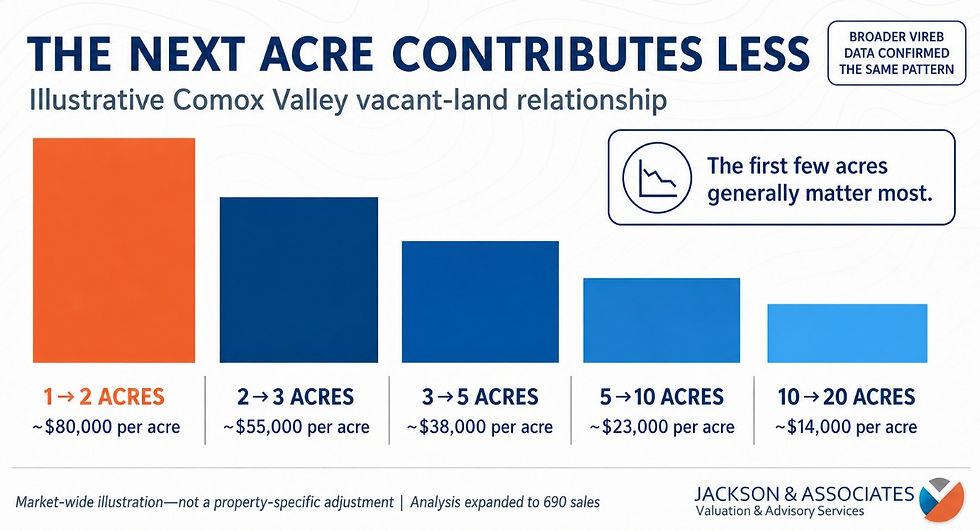
The Comox Valley vacant-land relationship can be illustrated with a normalized value curve:
Parcel size | Illustrative market value |
1 acre | Approximately $480,000 |
2 acres | Approximately $560,000 |
3 acres | Approximately $615,000 |
5 acres | Approximately $690,000 |
10 acres | Approximately $805,000 |
20 acres | Approximately $945,000 |
This illustrates the overall market relationship. It is not an adjustment table for individual properties.
The implied contribution per additional acre declines as the parcel becomes larger:
From one to two acres: approximately $80,000
From two to three acres: approximately $55,000
From three to five acres: approximately $38,000 per additional acre
From five to ten acres: approximately $23,000 per additional acre
From ten to twenty acres: approximately $14,000 per additional acre
The parcel keeps getting larger, but each additional acre represents a progressively smaller portion of its total value.
This is known as diminishing marginal utility.
The first few acres usually provide the greatest residential benefit. Later acres may still add privacy, agricultural utility or future possibilities, but they do not usually contribute at the same rate.
What Gene Dilmore’s work tells us about size adjustments
Appraisers have long recognized that size adjustments are not linear. Gene Dilmore’s published work on land-size adjustments applied mathematical curves to the relationship between parcel size and unit value. His 1995 article, Size Adjustments: Getting with the Program, described a process for selecting a size-adjustment curve from market evidence.
The underlying concept remains highly relevant: as the quantity of land increases, buyers generally pay a lower rate per unit.
However, size is rarely the only variable.
Later Canadian appraisal writing discussing Dilmore’s contribution emphasized that price differences may also result from location, land use, soil, drainage and productivity.
A visible price-per-acre pattern does not prove that size alone caused the difference.
That caution is directly supported by the Comox Valley and broader VIREB data.
Our analysis does not reproduce Dilmore’s original software or establish a universal “Dilmore curve.” It provides a current Vancouver Island example of the same longstanding valuation principle:
Size matters, but it must be analyzed together with the other characteristics that create utility and value.
Why five acres is not always five acres
Consider two vacant five-acre parcels.
The first is level, private and well drained. It has good road access, reliable water, favourable soils and an attractive building site.
The second contains a steep ravine, seasonal water, difficult access and only one practical building area.
Both properties contain five acres.
Buyers are unlikely to value those acres equally.
The same problem arises with improved properties.
Imagine a renovated 2,500-square-foot house on two acres and an older 1,500-square-foot house on five acres. If the two-acre property sells for more, that does not mean the additional three acres have negative value.
It means the house, condition, location and other property characteristics outweighed the acreage difference.
Buyers do not purchase acreage as an abstract number. They purchase the utility, privacy, setting and opportunities the land provides.
Why location can outweigh acreage
Regional vacant-land medians further demonstrate the importance of location:
VIREB region | Sales | Median acreage | Median sale price |
Parksville-Qualicum | 72 | 5.00 | $600,000 |
Duncan area | 67 | 3.80 | $523,703 |
Comox Valley | 57 | 3.65 | $625,000 |
Port Alberni area | 44 | 3.67 | $455,000 |
Malahat area | 44 | 5.00 | $550,000 |
Nanaimo area | 28 | 2.47 | $683,750 |
Campbell River area | 9 | 3.23 | $560,000 |
Nanaimo recorded the highest regional median price despite having the lowest median parcel size among the larger regional groups.
Port Alberni had similar median acreage to the Comox Valley but a substantially lower median price.
An acre does not have the same contributory value in every community. It may not even have the same contributory value within one community.
Proximity to services, neighbourhood character, privacy, access, views, waterfront, zoning, soil conditions and development potential can all affect what buyers are willing to pay.
Three acreage valuation myths
Myth 1: Find the local price per acre and multiply
Price per acre changes dramatically with parcel size.
Applying the price per acre from a 1.5-acre sale to a ten-acre property would likely overstate the value of the larger parcel.
Myth 2: The price difference equals the value of the extra land
Two acreage sales rarely differ only in land area.
House size, age, quality, condition, location, shops, barns, secondary accommodation, waterfront and views may explain much of the difference.
Myth 3: Every acre contributes equally
The first few usable acres may provide the homesite, yard, privacy, septic field, garden, pasture or space for a shop.
Later acres may offer additional privacy or agricultural utility, but their contribution is usually smaller—particularly if they are steep, wet, inaccessible or restricted.
Why properties over 20 acres are different
The largest parcels behaved differently from conventional rural-residential acreages.
Across the broader VIREB dataset, the vacant land sales included remote recreational parcels, agricultural holdings, water-access properties and potential development sites.
Once parcels become sufficiently large, agricultural, resource and development utility can become more important than ordinary residential acreage.
The analysis shifts from “How many acres are there?” to more property-specific questions:
How much of the site is usable?
What does the zoning permit?
Is the property within the Agricultural Land Reserve?
Can it be subdivided?
Does it generate agricultural income?
What buildings and infrastructure are included?
Is it serviced or easily accessible?
Does it have waterfront, views or another unusual influence?
A 50-acre farm is not simply a five-acre residential property multiplied by ten.
What determines the value of additional acreage?
The contribution of additional land depends on several interacting factors:
Existing parcel size: An extra acre usually matters more when added to a smaller parcel.
Location: Demand and price levels vary throughout Vancouver Island.
Usable area: Level, accessible land generally offers greater utility.
Zoning: Permitted uses can materially affect value.
ALR status: Agricultural restrictions and opportunities influence the buyer pool.
Servicing: Water, septic suitability, utilities and road access matter.
Privacy and setting: Additional land may create valuable separation from neighbours.
Outbuildings: Shops, barns, fencing and other improvements affect how acreage can be used.
Development potential: Subdivision or additional-dwelling potential can overwhelm the ordinary acreage relationship.
Waterfront and views: Special-location influences may matter more than parcel size.
The important question is not simply:
How many acres does the property contain?
It is:
What does the additional land allow a buyer to do?
About the acreage analysis
We reviewed 369 improved single-family acreage sales and 57 vacant land sales in the Comox Valley, together with another 264 vacant land sales elsewhere in the VIREB market area. All properties contained at least one acre and sold between 2022 and 2026.
The improved-property analysis considered acreage together with finished house area, house age, bedrooms, bathrooms, garage spaces, geographic submarket and sale year.
The vacant-land analysis considered acreage, geographic submarket and sale year.
The available data did not contain consistent fields for property condition, waterfront, views, outbuildings, secondary dwellings, servicing or usable land area. The findings therefore describe broad market relationships rather than property-specific appraisal adjustments.
Unusual and very large properties were considered separately because agricultural, resource, development and special-property influences can overwhelm the ordinary rural-residential acreage relationship.
So, what is an extra acre worth?
The data does not produce one universal dollar figure and that is the point.
The value of the next acre depends on how much land the property already has, where it is located, whether the land is usable and what opportunities it provides.
Across 690 Vancouver Island transactions, more land generally meant more value. However, the contribution declined as parcel size increased.
The first few acres usually matter most. After that, utility matters more than the number on the listing.
Jackson & Associates provides rural and acreage property appraisal services throughout the Comox Valley and Vancouver Island.
Acreage properties are rarely well served by simple price-per-acre comparisons. When a valuation involves unusual land, improvements, zoning or development potential, the analysis must reflect how buyers actually use and compare the property.
This analysis illustrates broad market relationships and should not be interpreted as an appraisal of any individual property. Individual results may differ significantly because of location, zoning, improvements, condition, waterfront, views, servicing, usable land area and development potential.


Comments