


New Building, Long Timeline. Why the First Depreciation Report Matters More Than Most Strata's Realize
When many people think about depreciation reports, they picture older buildings.
They think about aging roofs, worn exterior finishes, failing membranes, outdated mechanical systems, and major capital projects that can no longer be postponed.
But some of the most important depreciation reports are completed much earlier than that.
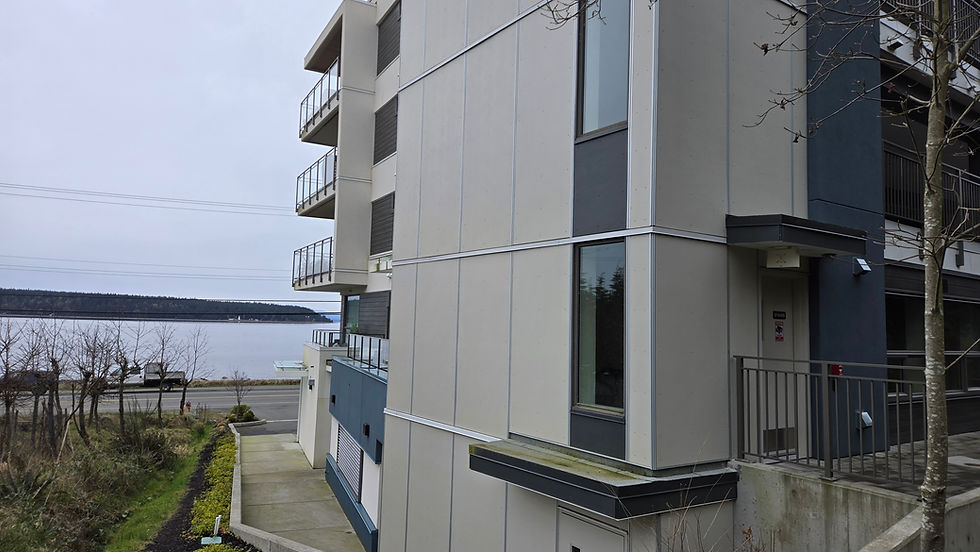
This week, we inspected a newer 5-storey apartment condominium building on Vancouver Island for its first depreciation report. The building features modern architecture, expansive ocean views, and construction over a grade-level parking structure. On first impression, it presents the way many newer condominium developments do. Clean, contemporary, and relatively low-maintenance at a glance.

That first impression can be misleading. A new or newer building does not remove the need for long-term capital planning. In many cases, it makes early planning even more important.
Why the first depreciation report matters
A depreciation report is not simply a list of components with estimated dates beside them.
At its best, it is a long-term planning document that helps a strata corporation understand what it owns, how shared components are likely to age, what major expenditures may arise over time, and whether current reserve fund contributions are aligned with future obligations.
For a newer building, the first report is especially important because it establishes the foundation.
It creates the initial capital inventory. It identifies the major common property systems. It sets out anticipated maintenance and replacement patterns. It helps frame realistic conversations about reserve fund planning before the strata is forced into reactive decision-making.
If that foundation is incomplete or unrealistic, the consequences often show up years later through underfunding, deferred maintenance, or special levies that catch owners off guard.
Newer buildings are often more complex than they appear
One of the most common misconceptions in strata governance is that a newer building should not require much planning because everything is still early in its life cycle.
That is not always true.
Modern buildings are often more complex than older ones.
Contemporary apartment and condominium projects may include:
large glazing systems
multiple balconies and horizontal waterproofed surfaces
more detailed cladding transitions
rooftop mechanical equipment
sophisticated security and access systems
elevators and life safety systems
parkade structures with drainage, ventilation, and waterproofing considerations
architectural detailing that improves appearance but introduces additional maintenance interfaces
These systems do not all age at the same rate. They also do not carry the same financial risk if neglected.
Some components may require cyclical maintenance. Others may involve major one-time renewal events. Some may have long theoretical lifespans but still warrant close monitoring because failure can be costly and disruptive.
That is why a good first depreciation report matters. It helps strata councils understand the difference.
The grade-level parking structure changes the planning discussion
In this case, one of the more important building features is the grade-level parking structure.
That is not a small detail.
Structures that incorporate parking areas introduce a range of long-term considerations that are often underestimated in early budgeting discussions. Even when the structure is relatively new, future planning should account for items such as:
concrete durability
crack monitoring and localized repairs
slab drainage performance
waterproofing details
parkade ventilation systems
overhead doors and access controls
lighting and safety systems
moisture management and long-term exposure conditions
These may not all become near-term expenditures, but they are exactly the types of building elements that should be identified and planned for early.
When omitted or underestimated at the start, they have a way of becoming expensive surprises later.

Coastal location matters
Communities on the coast of Vancouver island such as Campbell River, Comox, Qualicum and Parksville offer obvious lifestyle and market appeal, especially for residential buildings positioned to capture water views and a strong West Coast setting.
But location also matters from a building performance standpoint.
Coastal environments can place additional demands on exterior components. Moisture, wind, salt-laden air, and exposure conditions can all affect the long-term performance of building materials and assemblies.
That does not mean there is immediate concern. It means there should be informed planning.
Metal components, sealants, guardrails, balcony assemblies, flashings, exposed finishes, and certain envelope details may all perform differently depending on the specific design, product selection, construction quality, and maintenance standards over time.
This is one reason local experience matters in reserve fund planning. Published life expectancies are useful, but real-world performance is shaped by local conditions, design detail, exposure, and how well a building is maintained.
A good report answers the right questions early
A well-prepared first depreciation report should help a strata corporation answer several key questions.
What do we own?
This sounds simple, but it is essential. A strong inventory is the basis for all future planning.
What will need maintenance, repair, or replacement, and when?
Not every future cost is a full replacement event. Some components require recurring maintenance, restoration, or partial renewal.
Which building systems deserve the closest monitoring?
Some items may not be immediate concerns, but they can have significant financial consequences if performance issues develop.
Are reserve fund contributions on a realistic path?
This is where planning becomes governance. A report should support better funding decisions, not just describe a building.
The risk of waiting too long
In our view, one of the biggest mistakes a newer strata can make is assuming long-term capital planning is something to deal with later.
Later often means:
when costs are higher
when inflation has already affected replacement budgets
when deterioration is beginning to appear
when councils are under pressure
when owners are less receptive to contribution increases
when special levies become harder to avoid
Early planning does not eliminate future costs.
It does something more important.
It gives the strata time, structure, and visibility.
That allows councils to make more measured decisions, communicate more clearly with owners, and reduce the risk of sudden financial strain.
A depreciation report should not be treated as a compliance exercise
Too often, depreciation reports are viewed as a box to check.
That is the wrong mindset.
A properly prepared report should be treated as one of the most important planning documents a strata corporation will receive. It is a tool for stewardship, budgeting, and governance. It helps councils and owners understand that a well-performing building does not stay that way by accident.
It stays that way through informed decisions made consistently over time.
Final thought
A new building may not look like it needs a depreciation report.
That is exactly why it does.
The first report is where the long-term roadmap begins. It is where a building’s future repair and replacement obligations are first organized into a framework that council can understand, plan around, and act on.
For stratas in Campbell River and across Vancouver Island, early reserve fund planning is rarely wasted effort.
In many cases, it is one of the clearest signs of strong governance and responsible building stewardship.

Comments